How Is Fuel Polishing Different From Simply Cleaning the Tank It's In?

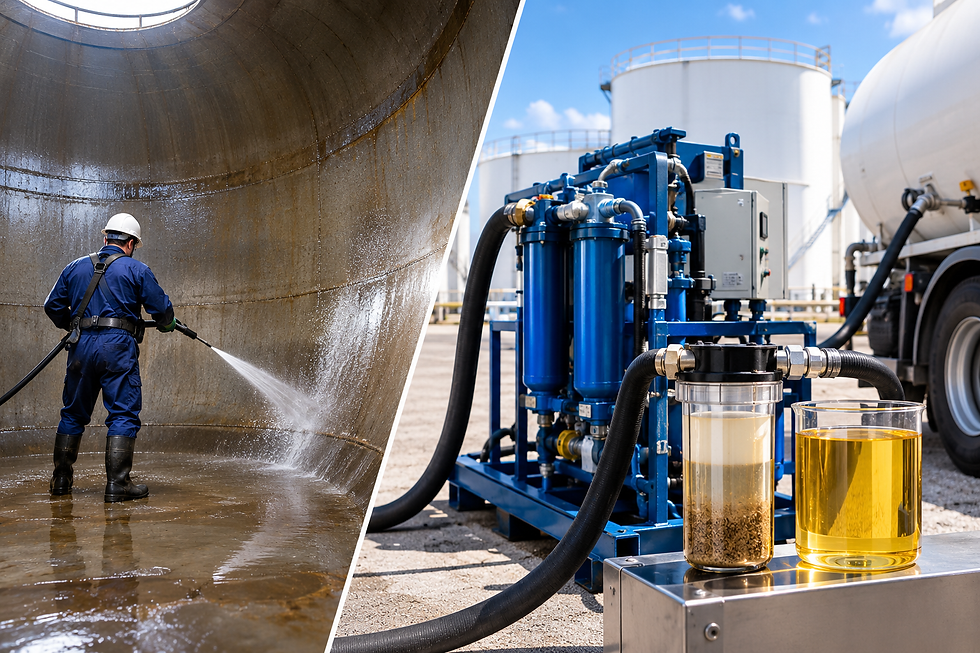
Ask most people what fuel maintenance means and they will describe cleaning a tank. Fewer people realise the fuel sitting inside that tank needs its own separate treatment, one that has nothing to do with scrubbing the container itself.
Two Jobs That Often Get Confused
Tank cleaning and fuel treatment sound similar enough that operators sometimes assume one covers the other. They do not, and treating them as interchangeable is one of the more common gaps in fuel maintenance planning.
Fuel polishing services focus entirely on the liquid itself, removing contaminants that have built up in the fuel over time, regardless of how clean or dirty the tank walls happen to be.
Tank cleaning, by contrast, addresses the storage vessel, removing sediment and buildup from the tank's interior surfaces rather than treating the fuel it contains.
What Actually Happens During Each Process
Understanding the difference becomes much clearer when you look at what each process physically involves.
Tank Cleaning Targets the Vessel
A tank cleaning job typically follows a defined sequence: inspection, preparation, sediment removal from the tank bottom, flushing of the tank and connected lines, and a final quality check. The focus throughout stays on the physical structure holding the fuel.
Fuel Polishing Targets the Liquid
Polishing works differently. Fuel gets extracted into mobile equipment, passed through multiple filtration stages to remove particles, separated from any water content, tested against quality standards, and then returned to storage. The tank itself is not the focus at any point in this process.
Why Fuel Degrades Even in a Clean Tank
This is where the distinction really matters. A tank can be completely clean, freshly serviced, with no sediment or buildup whatsoever, and the fuel stored inside it can still degrade over time.
Fuel naturally oxidises the longer it sits in storage without use
Chemical reactions during oxidation reduce fuel effectiveness gradually
Moisture from humid air or condensation can enter fuel even in a clean tank
Temperature changes accelerate the degradation process regardless of tank condition
None of these factors depend on whether the tank itself has been cleaned recently. Fuel ages on its own timeline, driven by chemistry rather than tank hygiene.
Why This Surprises Some Operators
Because tank cleaning is the more visible, more commonly known service, it is easy to assume that a recently cleaned tank means the fuel inside is also in good condition. That assumption misses an entire category of degradation that has nothing to do with the tank's physical state.
When Each Service Is Actually Needed
The two services also run on very different schedules, which reinforces just how separate they really are.
Tank cleaning is typically needed every one to three years, depending on usage and storage conditions. Fuel polishing runs on a tighter cycle, often recommended once or twice a year, because fuel degradation happens on a faster timeline than sediment buildup inside the tank.
A tank might need cleaning only every couple of years
Fuel inside that same tank might need polishing twice within that period
Both schedules operate independently of each other
Neither service substitutes for the other, even when timelines overlap
What You Get From Each Service
The practical benefits of each process differ in ways that reflect what they actually address.
Tank cleaning protects the storage vessel and prevents future contamination from sediment buildup, extending the life of the tank itself and reducing the risk of future fuel contamination.
Fuel polishing restores fuel that has already started to degrade, often saving fuel that would otherwise need to be discarded and replaced entirely. That difference translates directly into cost savings for operations storing significant fuel volumes.
Most Operations Actually Need Both
Rather than choosing one service over the other, most fuel storage operations benefit from running both on their respective schedules, treating them as complementary rather than competing options.
Tank cleaning keeps the storage environment free of sediment and buildup. Fuel polishing keeps the fuel itself in usable condition. Together, they cover the two separate points where contamination can develop: the vessel and the liquid it holds.
Bringing Both Services Into a Single Plan
Rather than scheduling each service reactively whenever a problem appears, a more effective approach folds both into an ongoing maintenance structure.
Fuel management services typically coordinate tank cleaning and fuel polishing alongside broader inspection and monitoring activities, rather than treating each as a standalone task booked only when something looks wrong.
That coordination matters because it accounts for how the two schedules interact. A site under a managed plan gets fuel polished on its own cycle while tank cleaning happens on a separate, longer interval, without either service being forgotten or delayed until a visible problem forces action.
How to Tell Which Service You Actually Need
For operators unsure which service applies to their current situation, a few questions help clarify the picture.
Has the tank itself been cleaned recently, or is buildup a known issue?
Has fuel been sitting in storage for an extended period without use?
Are there signs of reduced fuel quality despite a recently cleaned tank?
Is equipment showing performance issues that persist after a tank clean?
Answers to these questions usually point toward whichever service has been overlooked, and in many cases, the answer ends up being both.
The Bottom Line on This Distinction
Treating tank cleaning and fuel polishing as the same service leaves a gap in fuel maintenance that eventually shows up as reduced performance, wasted fuel, or equipment strain that a clean tank alone cannot explain.
Recognising them as two separate processes, each addressing a different source of contamination, is what allows a fuel storage system to actually stay reliable over the long term rather than only appearing well maintained on the surface.
FAQs
Q1: Can fuel polishing be done without cleaning the tank first?
Yes. Fuel polishing treats the fuel itself and does not require the tank to be cleaned beforehand, though a dirty tank may reintroduce contamination faster afterward.
Q2: How often should fuel polishing happen compared to tank cleaning?
Fuel polishing is typically recommended once or twice a year, while tank cleaning is usually needed every one to three years depending on usage.
Q3: Does a clean tank mean the fuel inside is also clean?
Not necessarily. Fuel can degrade through oxidation and moisture exposure even when the tank itself has no sediment or buildup issues.
Q4: Is fuel polishing cheaper than replacing degraded fuel?
In most cases, yes. Polishing restores existing fuel to usable condition rather than requiring it to be discarded and fully replaced.
Q5: Do all fuel types require the same polishing process?
The core process applies broadly, though equipment and methods are adjusted depending on whether the fuel is diesel, unleaded, or another type.
Comments